
Max drawdown and your usual trade size
Two numbers sit behind both the four requirements and the score: your usual trade size and your max drawdown. This page explains how each one is worked out.
Your usual trade size
Section titled “Your usual trade size”Your usual trade size is the typical size of the positions you open. Your drawdown, your return and your worst trade are all measured against it, so a trader who opens $200 positions and one who opens $20,000 positions are judged on the same scale.
- A trade starts when you open a position in a market and ends when that position is back to zero. Adding to the position is part of the same trade, and closing it in several steps is still one trade. Flipping from long to short closes one trade and opens a new one.
- The size of a trade is its notional at entry, in USDC: price times size of every fill that opened it or added to it. Margin and leverage don’t change it. A position with $100 of margin at 5x has an entry size of $500.
- Your usual trade size is the median of those entry sizes, over the trades you opened on Funded during the period. The period is everything since your window opened, or your last 30 days when you have no window open. We sort the sizes and take the one in the middle. With an even number of trades, it is the average of the two in the middle.
- Trades with any fill made outside Funded don’t count toward it, and neither do trades on markets that aren’t part of the program.
- It updates every 5 minutes as you open new trades. Deposits and withdrawals never move it.
Say you open five trades of $200, $240, $260, $300 and $500. Your usual trade size is $260. A single large trade doesn’t pull the median up the way it would pull up an average.
Max drawdown
Section titled “Max drawdown”Max drawdown is the biggest fall of your PnL from a high point to a later low during the window, in dollars, as a percentage of your usual trade size.
- Your PnL is your realized result (closed PnL, minus Hyperliquid’s trading fees, plus funding) plus the open PnL of your positions at the mark price. We record it every minute.
- Open positions count. If a position is up $100 and drops back to +$20 before you close it, that is an $80 drawdown, even though you closed it in profit.
- It looks at your whole account, trades made outside Funded included.
- Deposits and withdrawals are not part of your PnL, so moving money in or out never creates or removes a drawdown.
- The window is measured in whole UTC days, from the day it opened.
- The onchain.cc builder fee is still charged on every fill, but it isn’t subtracted from this PnL. Only Hyperliquid’s trading fees are.
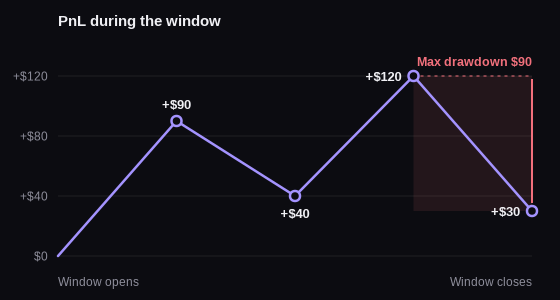
Take a usual trade size of $260. During the window your PnL rises to +$90, falls to +$40, rises to +$120 and then falls to +$30. The biggest fall from a high is $120 to $30, so $90. Your max drawdown is 90 ÷ 260 = 34.6%, and this window would miss the 25% requirement. With a usual trade size of $260, staying at 25% or less means your PnL never falls more than $65 below its highest point.
When it is checked
Section titled “When it is checked”The 25% requirement is checked once, when the window closes, so your drawdown can go over 25% during the window and the window keeps running. On the last day we take the largest fall in dollars over the whole window and divide it by your usual trade size on that day. The dollar figure never goes down: once a fall has happened, it stays your max drawdown for the rest of the window.
In the score
Section titled “In the score”The same two numbers feed your score. Return for the risk divides your return by your max drawdown, both as a percentage of your usual trade size, and a drawdown under 15% counts as 15%. The formula is on The score.